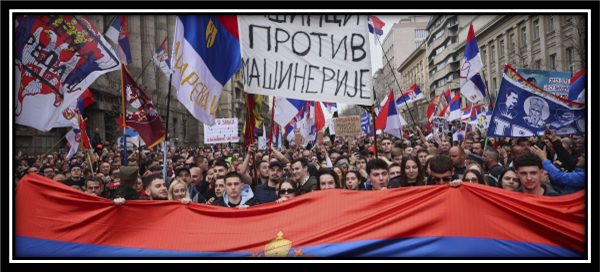
 - Human rights are often violated in the society we live in. As for the protests against the government corruption in Serbia, caused by the Novi Sad railway station canopy collapse, which killed 16 people, several human rights violations have been reported or alleged. This primarily relates to the state’s handling of protests, policing tactics, and suppression of dissent. Some of those rights include:
I The right to unhindered union activity:
- Workers are afraid to participate in protests because they're afraid of facing punishments and dismissal (For example, many workers who expressed their support for the student protests were fired, and also, educational workers who didn't hold classes often received salary cuts, sometimes not even paid, and they were also threatened by dismissal, which only put pressure on them);
II The right of children and young people to protection:
- Students who participated in protests often faced safety risks due to clashes with riot police and government supporters (For example, there were reports that riot police used excessive force, often including beatings with batons, the use of pepper spray and tear gas during arrests and while dispersing blockades, and among them, children were also hospitalized);
- Students can be also intiminated, and they can occur not only at protests, but also within schools and universities, usually in very disturbing ways (For example, on January 27th, 2025, an incident happen at Jovan Popović Elementary School in Novi Sad, when a dead rabbit was found hung up against the school fence with a tie, and this was one of the attempts by pro-government supporters to intiminate children, showing how in another way this right was violated);
III The right to live without fear:
- People were afraid of losing their jobs, being physically assaulted, or even facing false accusations simply for expressing support for the protests. (For example, numerous cases were reported where individuals who expressed support were often attacked, threatened, or even received death threats, highlighting a serious violation of the basic right to live without fear);
IV The right to privacy:
- People often faced monitoring, their personal data being doxed, filming without permision, and intrusion into their personal lives. Reports indicated that authorities tracked online activity, posts on social media, and private conversations, creating a climate where individuals are afraid of expressing their opinions freely. (For example, some professors who filmed students without their permission and posted them on social media violated the fundamental right to privacy);
V The right to media freedom:
- State media negatively presents protests, spreads disinformation, and censors the media. This limits public access to accurate information, undermined transparency, and also violates the right to media freedom (For example, censorship leads to the spread of lies, and some of them include the following: canopy wasn't reconstructed, the protests are organized by foreign countries, students attacked a police officer, the sound cannon wasn't used, the protests are the color revolution and several others);
VI The right to a fair trial:
- Protesters who were detained or charged often faced biased legal proceedings, with limited access to legal counsel and undue pressure from authorities. These violations show a significant threat to the fundamental principle of justice and the protection of human rights (For example, reports indicate that some trials were expedited or conducted in ways that compromised impartiality, raising concerns about the independence of the judiciary);
VII The right to peaceful assembly:
- Protesters were often intimidated by excessive police presence and the violent use of force. Authorities frequently employed batons, tear gas, mass arrests, and even a sound cannon to disperse protesters. Such tactics created an atmosphere of fear, discouraging people from exercising their right to gather and express dissent peacefully. (For example, excessive force was often used at protests, in the form of batons, tear gas, arrests, and even a sound cannon);
- In October 2025, Serbia proposed criminal law changes that will restrict peaceful protests, limiting free speech, expanding surveillance, and undermining justice for victims, suppressing dissent and democratic freedoms. (For example, by criminalizing road blockades during the protests, authorities restrict people from protesting, violating rights to peaceful asssembly and freedom of expression, which violates articles of the European Convention on Human Rights);
VIII The right to university autonomy:
- Incidents such as the attempted forced entry of authorities into faculties and interference with academic decision-making undermined the independence of universities. (For example, some known incidents include police invasions of universities in Novi Sad and Novi Pazar, where authorities attempted to disrupt normal academic operations. Such actions threatened the right of universities to operate free from political pressure);
IX The right to freedom of thought and political belief:
- People were pressured, intimidated, and even threatened with job loss or other reprisals for not supporting government policies or attending pro-government events, suppressing their right to hold independent political opinions. (For example, those who didn’t support the government were forced to attend pro-government rallies, while those who support it often recieved money, undermining the right to freely hold and act on political opinions);
X The right to protection from sexual abuse:
- Police subjected protesters, mainly women, to physical abuse, sexual threats, and harassment. Some were threatened with rape or publicly shamed, while authorities used gender-based violence to silence dissent. (For example, one known case happened with Nikolina Sinđelić, who was detained during the August 2025 protest in Belgrade and reportedly subjected to physical abuse and also threatened with sexual assault by Marko Kričak, the senior police commander of the special unit JZO);
- Another thing regarding the law changes, Serbia will also propose another criminal law change by introdusing “intercourse without consent” with lighter penalties than rape. That's exactly how it fails to fully protect victims, the law undermines the right to be free from sexual violence, torture, and degrading treatment. (For example, this change also discriminates victims who can't resist, and this also violates several articles of the European Convention on Human Rights).